
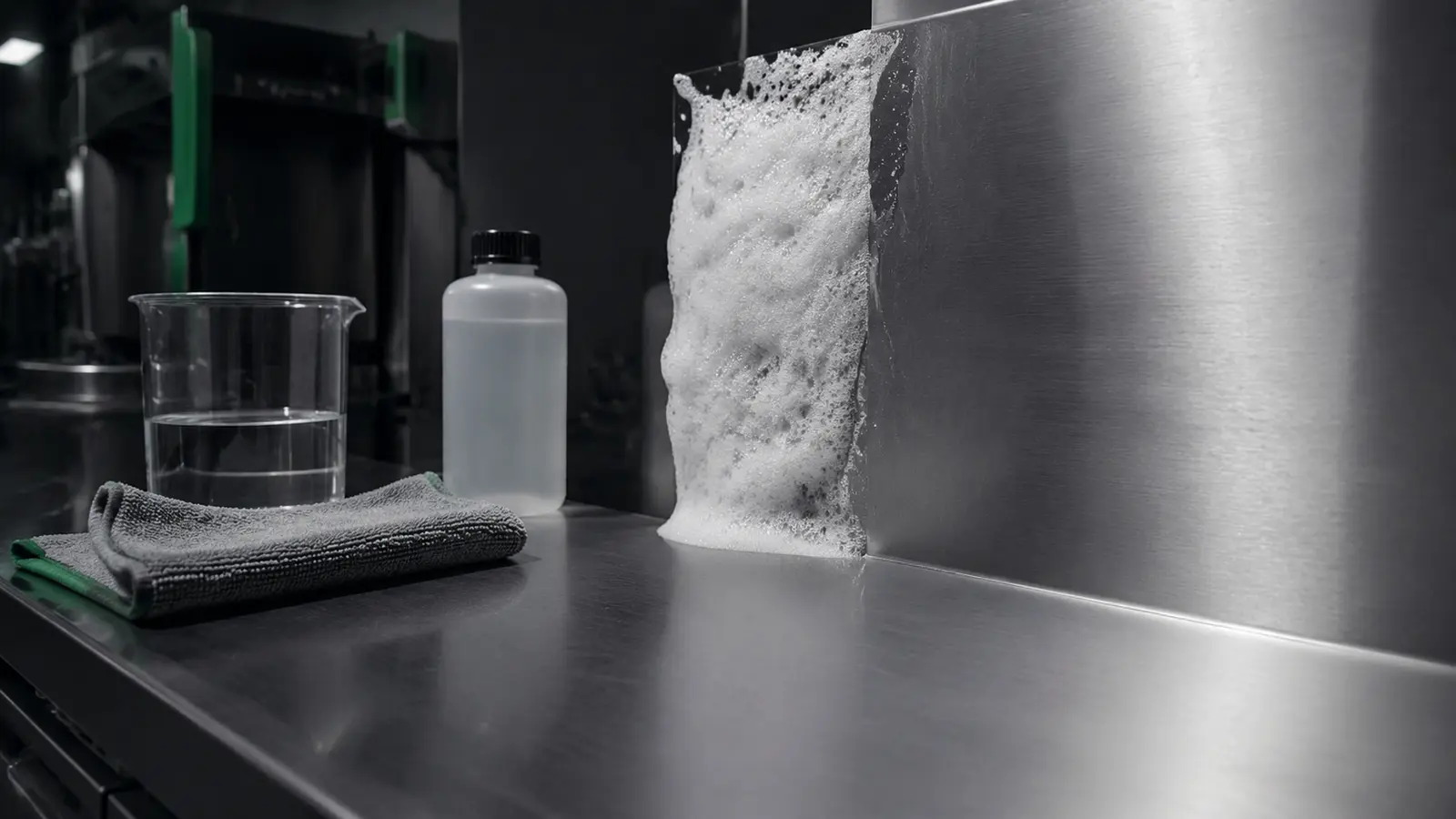
What foam actually tells you
Foam is mainly a visual effect of surfactants, water, air and mechanical movement. It can help an operator see where a product has been applied, but it does not automatically mean that grease, dust, fingerprints, soap deposits or industrial dirt are being removed more effectively.
When low foam is an advantage
Low-foam or controlled-foam formulas are useful for floor cleaning, machine-assisted cleaning, commercial premises with frequent cycles, streak-free surfaces and workflows where foam can interfere with process stability.
How to evaluate a professional cleaner
Start with the contamination, surface, application method, rinsing requirement, documentation and repeated-use conditions. Technical data sheets and safety data sheets help confirm whether a product fits the process before it is introduced.
Foam, concentration and dilution
Concentrated products can be efficient only when diluted correctly. Using too much product may increase residue, raise costs and create unnecessary rinsing work without improving the cleaning result.
Practical conclusion
Foam should be treated as one feature of a cleaning product, not as proof of effectiveness. In B2B cleaning, performance depends on chemistry, surface compatibility, contact time, dilution and process control.
When foam helps
On vertical surfaces, foam can extend contact time and show coverage. It still has to remain wet for the contact time defined by the instructions.
When foam is a problem
In scrubber dryers, extraction machines and circulation systems, excess foam can affect pumps, sensors and recovery. Low-foam products are often required.
Judge the dry surface
Wet shine can hide film, grease or streaks. The final result should be checked after drying, when the real condition is visible.
Related solutions
Explore the relevant product area and select a solution for your process.
View solutions →