
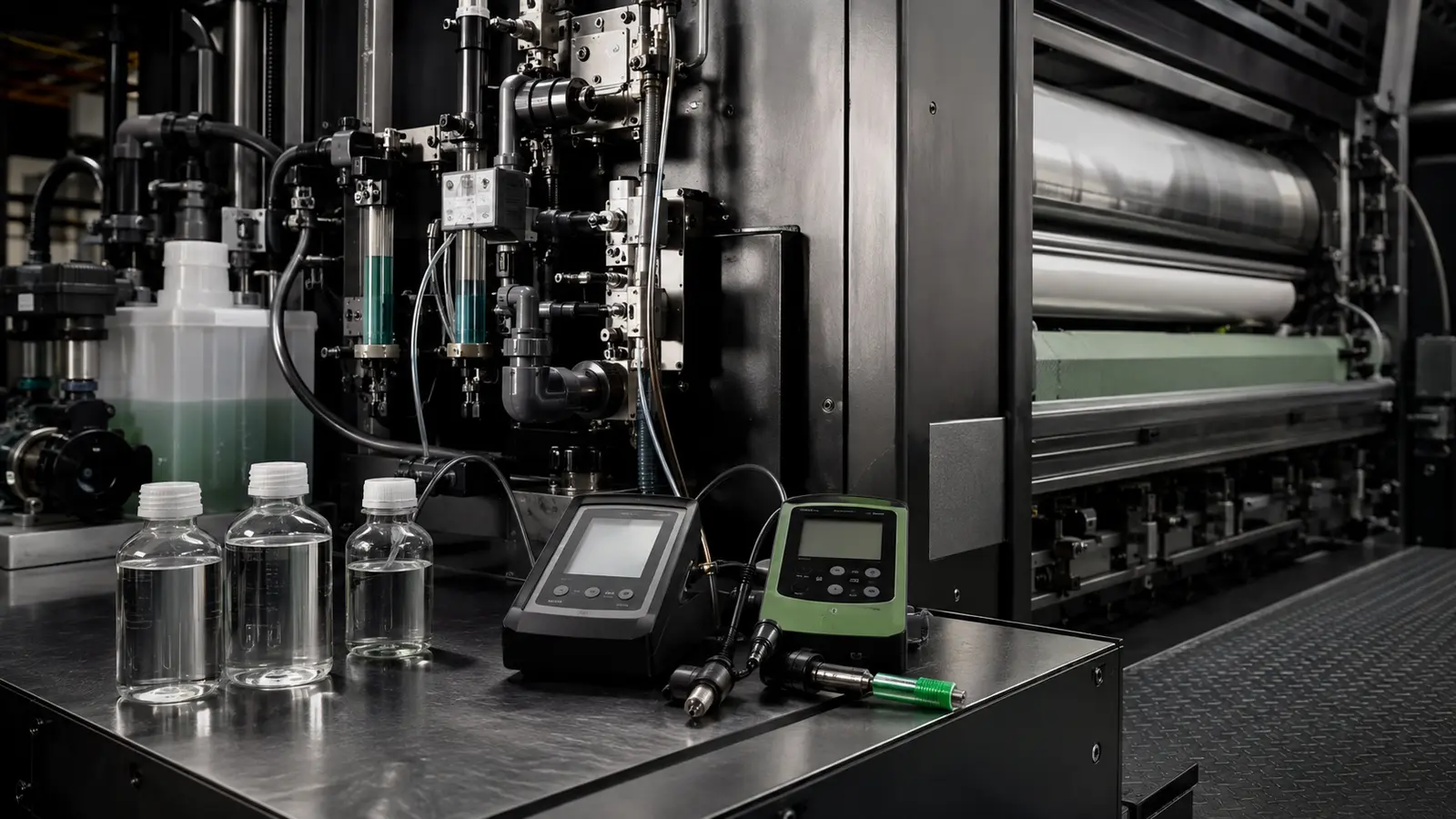
Establish a baseline
Record the current IPA level, temperature, pH, conductivity and press behaviour.
Check the water
Water hardness and composition affect the fountain solution. Use treated water or suitable correction where necessary.
Select the additive
It must be compatible with inks, plates and the press and support stable wetting rather than mask a mechanical issue.
Reduce in stages
Lower IPA gradually while keeping other variables stable. Watch toning, drying, ink–water balance and waste.
Standardise the process
Document working values, tolerances and monitoring frequency, and train operators.
Build a baseline first
Record IPA level, temperature, pH, conductivity, ink, plates and start-up waste across several typical jobs before making reductions.
Do not compensate with multiple changes
If toning or instability appears, return to the last stable setting. Avoid changing temperature, buffer dose and roller settings at the same time.
Calculate the full economics
IPA reduction is useful only if additive use, start-up time, waste, washing frequency and operator corrections do not increase more than the saving.
Related solutions
Explore the relevant product area and select a solution for your process.
View solutions →